The phrase Swiss movement replica Hublot watches appears precise, but it does not identify a single movement, construction standard or level of finishing. Two watches can use the same sales label while differing substantially in case architecture, dial layout and the mechanism beneath the display.
A useful comparison therefore starts with the specific Hublot collection and the functions the watch is meant to provide. The Big Bang, Square Bang and Classic Fusion share visible brand cues, yet their proportions and mechanical requirements are not interchangeable. This guide explains what to check before treating a movement label as meaningful evidence.
What Does “Swiss Movement” Actually Tell You?
At most, the phrase suggests a claimed origin for the movement or part of its assembly. It does not automatically identify the calibre, prove that the movement is a clone of an original Hublot mechanism or guarantee that every visible function works as expected. A seller should be able to name the movement family and explain the winding, date and chronograph operation.
- Ask for the actual calibre or base movement rather than a quality label.
- Confirm whether decorative plates hide a simpler movement underneath.
- Check the position of the date window and subdials against the reference.
- Verify which pushers operate real functions and which details are decorative.
- Consider serviceability and replacement parts as well as appearance.
A movement can be reliable without copying the architecture of the original watch. The important point is accuracy of description: visual similarity, mechanical similarity and country-of-origin claims are three separate questions.
Quick Comparison of the Main Hublot Designs
| Collection | Main visual feature | Useful comparison point |
|---|---|---|
| Big Bang | Layered round case and bold bezel | Case thickness, subdial spacing and strap integration |
| Square Bang | Square case with exposed screws | Case profile, screw alignment and chronograph layout |
| Classic Fusion | Cleaner, slimmer round case | Proportion, finishing and date placement |
| Spirit of Big Bang | Tonneau-shaped case | Curved case fit and openworked dial construction |
Square Bang: Case Architecture Comes First
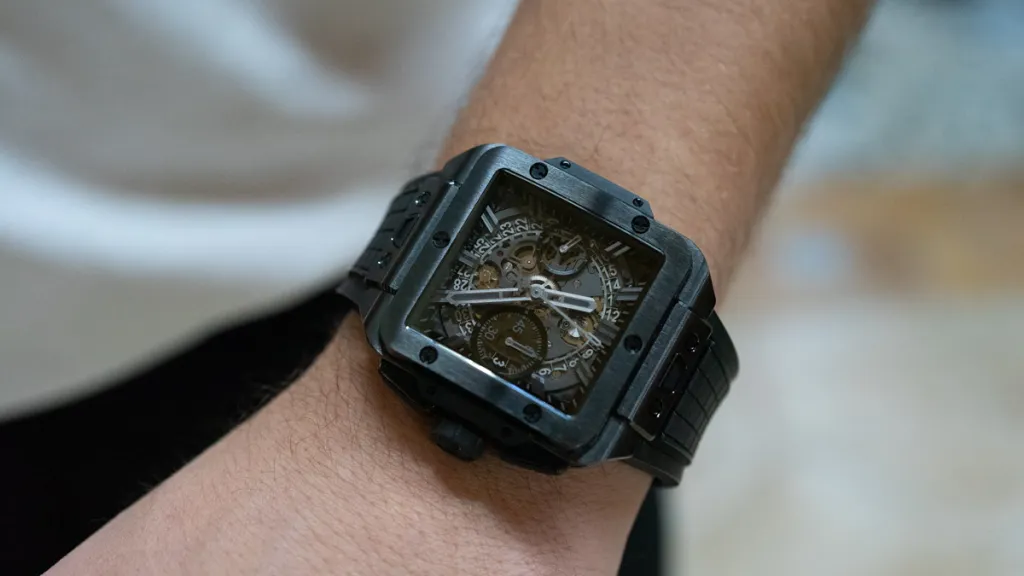
The Square Bang translates familiar Hublot elements into a case with straight sides and more obvious corners. That shape exposes proportion problems quickly. Compare the height of the bezel, the width of the case band and the way the strap enters the lugs. Bezel screws should sit evenly, and the chronograph subdials should not appear squeezed toward the centre.
Movement choice affects more than timekeeping. It can determine subdial spacing, date position and total case thickness. A visually decorated movement may create the expected view through the caseback while using a different underlying architecture. Readers can browse the dedicated Square Bang collection for related coverage.
Classic Fusion Chronograph: Simplicity Makes Errors More Visible

The Classic Fusion uses a cleaner case than the Big Bang, so poor alignment and inconsistent finishing have fewer places to hide. On chronograph versions, inspect the relationship between the subdials, date window and applied markers. The pushers should align cleanly with the crown, and polished surfaces should not blur into adjacent brushed areas.
Gold-tone finishes require particular care. Colour should remain consistent across the bezel, case and clasp, while edges should look controlled rather than soft. The movement should also match the advertised functions; a running seconds display is not the same as an operating chronograph.
Classic Fusion 38mm: Diamonds Do Not Replace Proportion
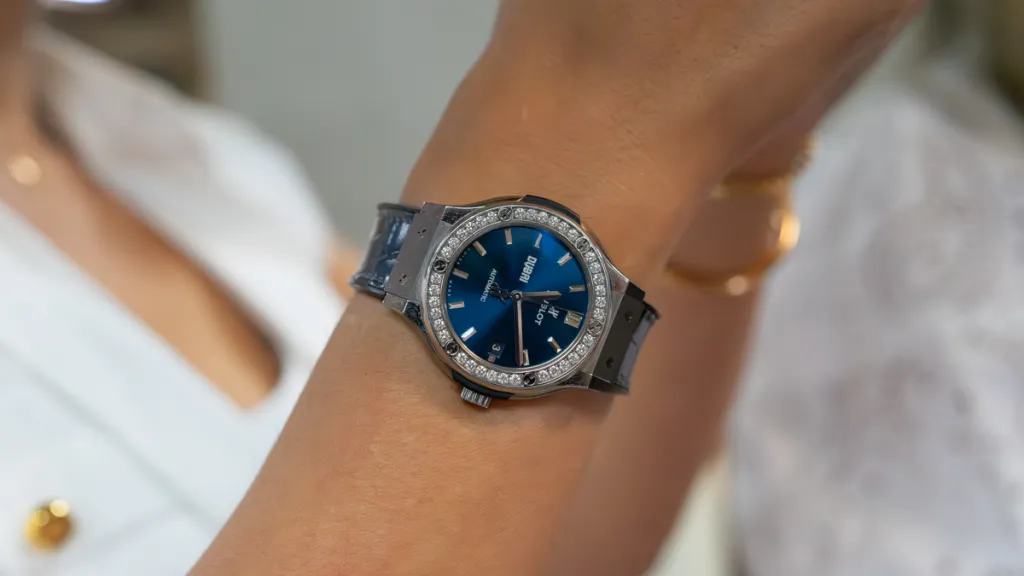
A smaller Classic Fusion places more emphasis on dial balance and bezel width. If decorative stones are present, check spacing, alignment and setting height before considering brilliance. Uneven rows or a bezel that appears too thick can change the character of the entire watch.
The date should sit squarely in its opening, the hands should clear the applied markers and the crown should remain proportional to the case. A simple automatic movement can be a practical choice if its identity and functions are described honestly. The Classic Fusion archive provides more examples of the collection’s restrained design.
Classic Fusion Titanium Green: Check Colour and Surface Treatment
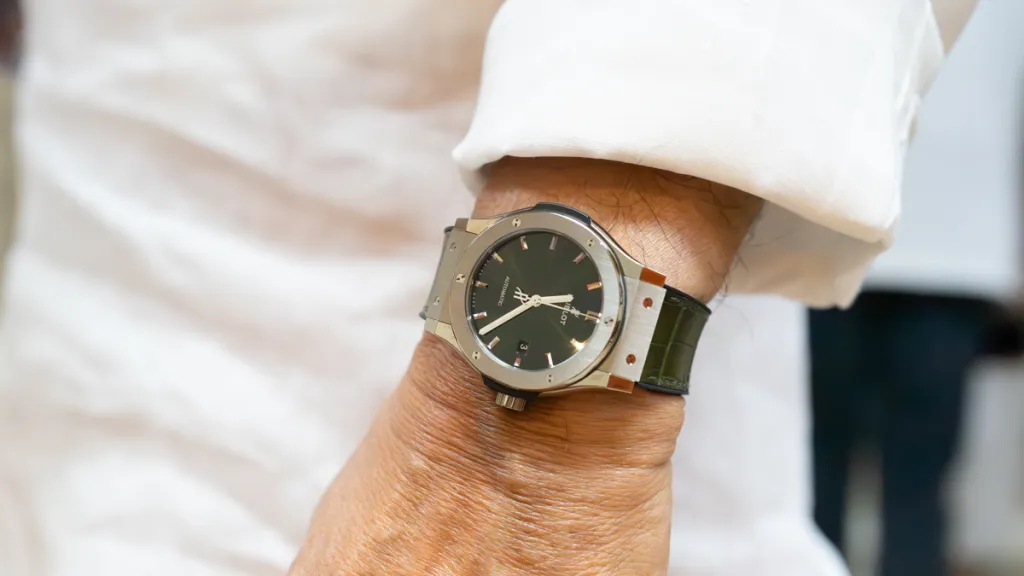
Titanium-style cases should show a controlled, even surface rather than the bright appearance associated with highly polished steel. On a green dial, compare colour under several lighting conditions and check whether the sunburst or matte treatment is consistent from the centre to the minute track.
The strap should meet the case without a large gap, and its texture should not be used to imply a material that has not been verified. On any automatic version, listen for excessive rotor noise, test hand winding and confirm that the date changes predictably around midnight.
How to Compare a Replica Hublot in Practice
Begin with the exact reference, not the brand name alone. Collect clear photographs of the front, side, caseback, crown, clasp and strap connection. Then compare dimensions, dial layout and functions in that order. This prevents an attractive dial from distracting from an incorrect case profile or a movement that cannot support the visible complication.
- Identify the collection and reference the watch is intended to represent.
- Check diameter, thickness and lug-to-lug proportions.
- Compare bezel screws, markers, hands, date placement and subdial spacing.
- Test winding, time setting, date setting and every chronograph pusher.
- Confirm the movement family and realistic service options.
- Inspect the strap, clasp and case finishing under neutral light.
The broader replica Hublot watches guide connects these checks with the Big Bang, Classic Fusion and Spirit of Big Bang families. For movement terminology beyond one brand, see our watch knowledge section.
Conclusion
A Swiss movement label should begin a comparison, not end it. The strongest evidence comes from a named calibre, functions that operate as described, proportions that match the intended reference and construction that can be inspected from more than one angle. For Hublot-inspired watches in particular, case architecture and movement layout are closely connected, so both need to be evaluated together.